
Docs
RunMacro Documentation
Create your first robot, then go further as needed.
Clear step-by-step guides to create, run, and improve robots for repetitive computer work.
Append a line to a text file in RunMacro
The Append Text File command adds text to the end of a TXT file (without overwriting existing content).
Prerequisites#
- Add Append Text File to the macro.
- Prepare the data or target that Append Text File will use.
Supported modes#
- RunMacro Runner
What it does#
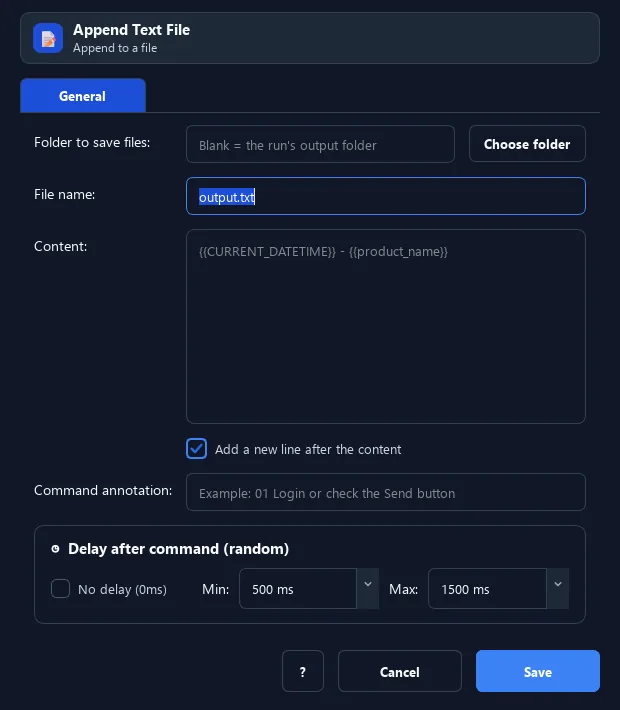
The Append Text File command adds text to the end of a TXT file (without overwriting existing content). It supports variables in the content and auto-creates the file/folder if missing.
Screenshots & video#
When to use it#
- Write a data log to a file to keep it.
- Accumulate results line by line across runs.
- Save a list (emails, tokens...) to TXT.
When not to use it#
- Do not use it for structured data, lock-required concurrent writes, or encrypted content.
Configuration steps#
- Add a File › Append Text File command.
- Choose the file path (and output folder if needed).
- Enter the content (variables supported); choose whether to add a newline. Save.
Every option explained#
Expected result#
After execution, Append Text File completes the described action and makes its result available to the next step.
Real example#
Example: append an email to a list#
- Append Text File
emails.txt, content{email}, newline on. - Each run appends one email to the file.
Limitations and failure cases#
- Encoding, newlines, permissions, and multiple writers can corrupt/interleave text; the operation only appends.
Tips & common mistakes#
For structured multi-column output, use Append Custom CSV Row or Data Source - Write Variables.
Verification details#
commands/data_source.py