
Docs
RunMacro Documentation
Create your first robot, then go further as needed.
Clear step-by-step guides to create, run, and improve robots for repetitive computer work.
Send an HTTP request (call an API) in RunMacro
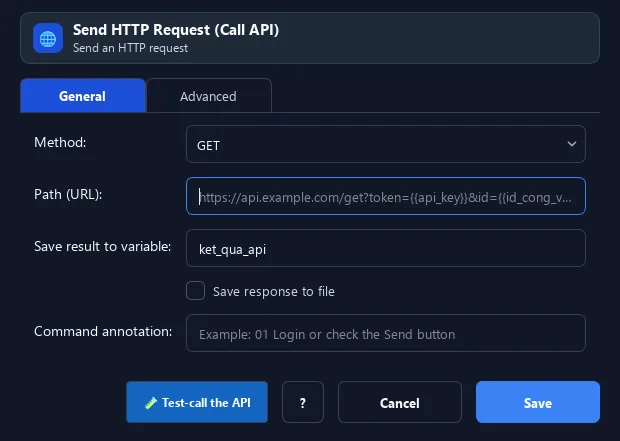
The HTTP Request command sends a GET or POST to an API (with headers and body if needed), then stores the response in a variable.
Prerequisites#
- Add HTTP Request to the macro.
- Prepare the data or target that HTTP Request will use.
Supported modes#
- RunMacro Runner
What it does#
The HTTP Request command sends a GET or POST to an API (with headers and body if needed), then stores the response in a variable. It can filter the response with regex to grab the needed part (e.g. an OTP).
Screenshots & video#
When to use it#
- Fetch an OTP/data from a service API.
- Send data to a webhook/endpoint.
- Integrate an API call into an automation workflow.
When not to use it#
- Do not use it with untrusted endpoints, secrets in URLs/logs, or transactions requiring a specialized atomic client.
Configuration steps#
- Add a Network › HTTP Request command.
- Choose the method (GET/POST), enter the URL, and optional headers and body.
- Set the result variable.
- (Optional) enable regex filter and enter a pattern. Save.
Every option explained#
Expected result#
After execution, HTTP Request completes the described action and makes its result available to the next step.
Real example#
Example: fetch an OTP from an API then fill it#
- HTTP Request GET to the OTP API URL.
- Enable regex
\d{6}→ variableotp. - Use
{otp}to fill the code field.
Limitations and failure cases#
- Timeout, DNS/TLS, HTTP status, and response format can fail; a response does not prove business success.
Tips & common mistakes#
Combine with Extract Regex for more complex response parsing.
Verification details#
commands/network.py