
Docs
RunMacro Documentation
Create your first robot, then go further as needed.
Clear step-by-step guides to create, run, and improve robots for repetitive computer work.
Wait a random amount of time in RunMacro
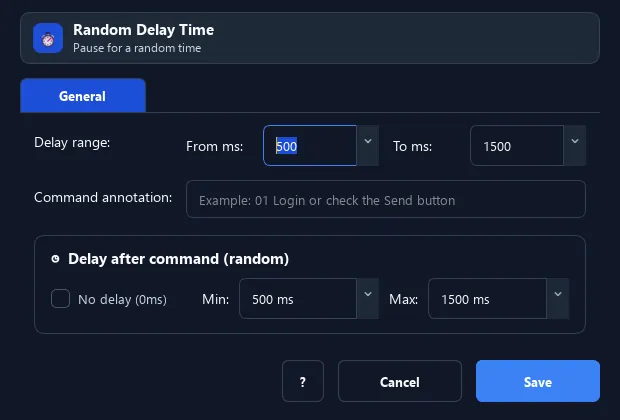
The Random Delay command pauses the script for a random duration between the min and max you set (in milliseconds).
Prerequisites#
- Add Random Delay to the macro.
- Prepare the data or target that Random Delay will use.
Supported modes#
- RunMacro Runner
What it does#
The Random Delay command pauses the script for a random duration between the min and max you set (in milliseconds). It keeps the rhythm irregular and natural-timing.
Screenshots & video#
When to use it#
- Insert between actions to test a workflow under variable response times.
- Wait for a page/app with a varying duration.
- Do not use random delay to bypass abuse controls; follow the service terms and rate limits.
When not to use it#
- Do not use it to wait for a concrete condition or replace a state check.
Configuration steps#
- Add a Random › Random Delay command.
- Enter the min (ms) and max (ms).
- Save. Each run waits a random duration within that range.
Every option explained#
Expected result#
After execution, Random Delay completes the described action and makes its result available to the next step.
Real example#
Example: wait a random 0.5–1.5 seconds#
- Random Delay, min=500, max=1500.
- Place it between type/click steps for a natural feel.
Limitations and failure cases#
- Nondeterministic timing makes tests harder to reproduce and does not prove the previous action finished.
Tips & common mistakes#
Use Random Delay instead of a fixed Wait when you want less predictable behavior.
Verification details#
commands/random_cmd.py