
Docs
RunMacro Documentation
Create your first robot, then go further as needed.
Clear step-by-step guides to create, run, and improve robots for repetitive computer work.
Generate a random decimal in RunMacro
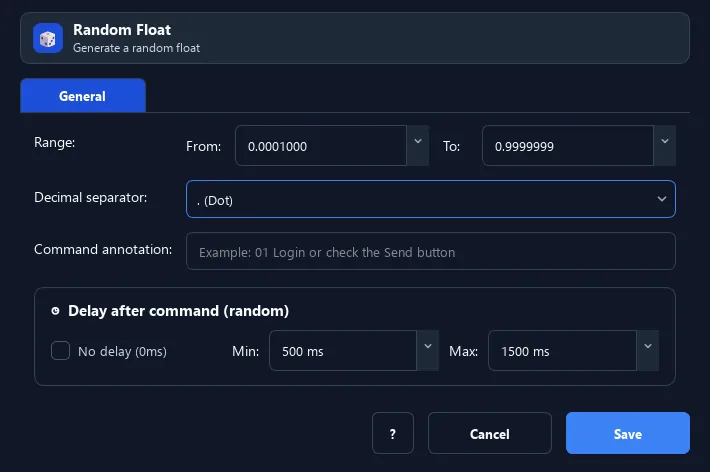
The Random Float command generates a random decimal within a min–max range, lets you pick a dot (.) or comma (,) separator, then places it in the clipboard.
Prerequisites#
- Add Random Float to the macro.
- Prepare the data or target that Random Float will use.
Supported modes#
- RunMacro Runner
What it does#
The Random Float command generates a random decimal within a min–max range, lets you pick a dot (.) or comma (,) separator, then places it in the clipboard.
Screenshots & video#
When to use it#
- Fill a random decimal (price, ratio...).
- Create decimal test data.
- Fit forms that use a comma decimal (VN format).
When not to use it#
- Do not use it for exact financial arithmetic or cryptographic values.
Configuration steps#
- Add a Random › Random Float command.
- Enter min, max and choose the separator.
- Save. The result is in the clipboard.
Every option explained#
Expected result#
After execution, Random Float completes the described action and makes its result available to the next step.
Real example#
Example: a 0–1 decimal with comma#
- Random Float, min=0, max=1, comma separator.
- Paste from Clipboard into the field.
Limitations and failure cases#
- Floating-point formatting and rounding depend on bounds/locale; the destination must accept the text.
Tips & common mistakes#
Pick the separator matching the app locale to avoid number-format errors.
Verification details#
commands/random_cmd.py